KIMI K3.1-Pro Model Officially Released
Kimi has released K3.1 Pro, the first model in the K3.1 series. Positioned as its most powerful open-weight model to date with three trillion parameters, it supports a 1-million-token context window. Built upon an expanded training scale from K3, the model focuses on enhancing capabilities in programming, 3D creation, financial research, and complex agent tasks. A Highspeed version has also been launched, offering 2–3 times the speed of the standard edition.
KIMI K3.1-Pro Model Officially Released
Kimi has released K3.1 Pro, the first model in the K3.1 series. Positioned as its most powerful open-weight model to date with three trillion parameters, it supports a 1-million-token context window. Built upon an expanded training scale from K3, the model focuses on enhancing capabilities in programming, 3D creation, financial research, and complex agent tasks. A Highspeed version has also been launched, offering 2–3 times the speed of the standard version.
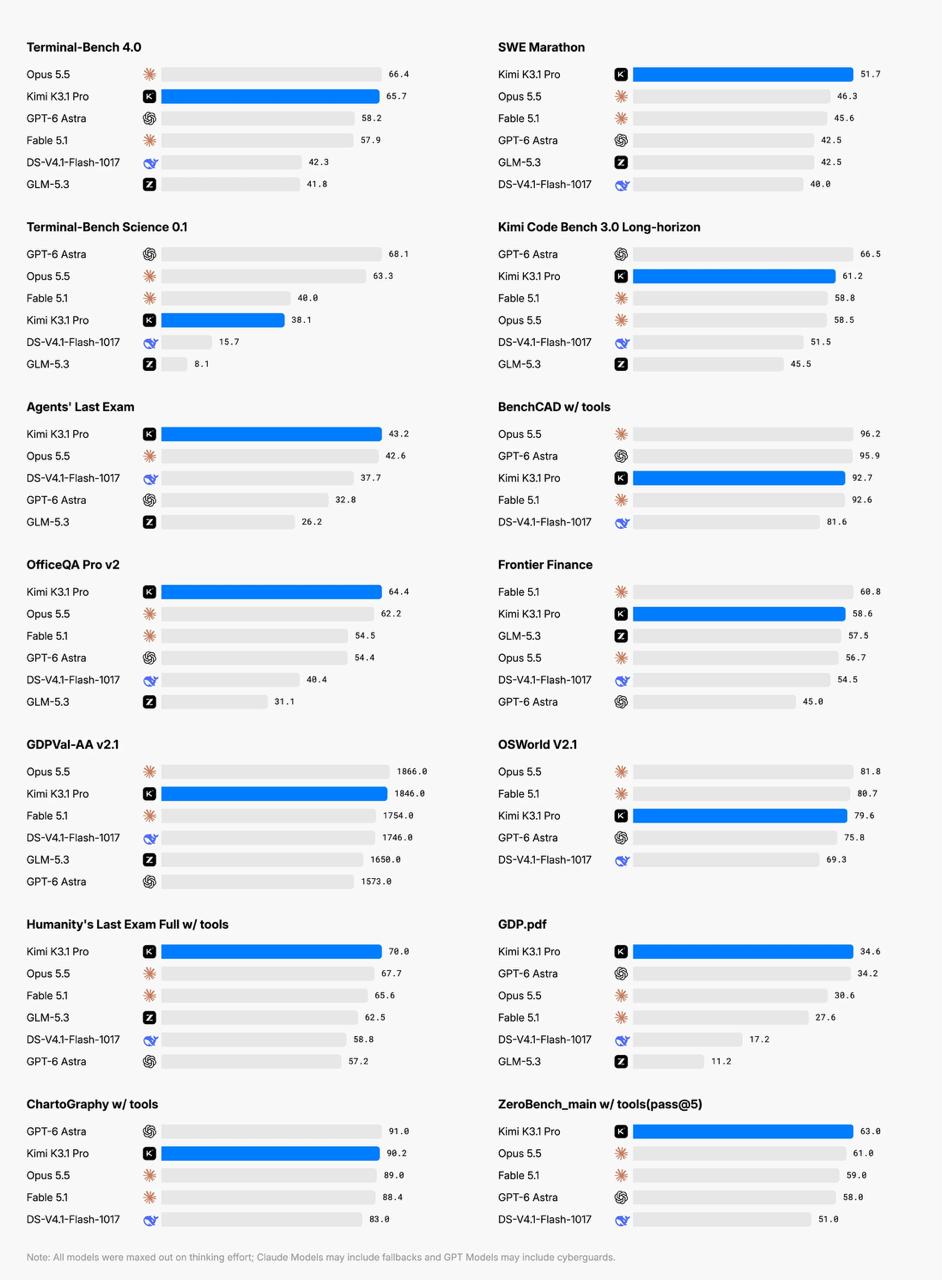
The programming upgrades center on long-process execution and complete project delivery. According to official data, it scored 65.7% on Terminal-Bench 4.0, surpassing GPT-6 Astra's 58.2% and approaching Claude Opus 5.5's 66.4%. Internal long-task programming tests saw an increase from K3's 55.95% to 61.2%. The model can develop games using Unity, Unreal, and Godot, and has improved visual rendering for web pages and 3D scenes.
3D modeling and financial workflows are standout features. The model can generate parametric models from text, sketches, or reference images, and manipulate Blender and CAD through scripts, achieving a 92.7% score on the BenchCAD tool. In financial applications, internal modeling and research tests improved by 7.2 and 11.6 points, respectively, while its simulation management performance is approximately 4.2 times that of K3.
Reliability has also seen significant improvement: in internal high-difficulty tests, the rate of assertional hallucinations dropped from 23.4% to 8.3%. However, the original text emphasizes that this does not reflect the error rate in everyday use.
The model is now available through Kimi, Work, Code, and the API. The full weights are scheduled to be released before November 4, 2026.
Source: Kimi Official Blog